Choosing wooden toys that are safe, simple and built to last
What to check before you buy a handmade wooden toy, from wood types and finishes to safety marks and age labels.
We independently choose everything we write about. Some outbound links are affiliate links, which help keep this site running at no cost to you. How we earn.
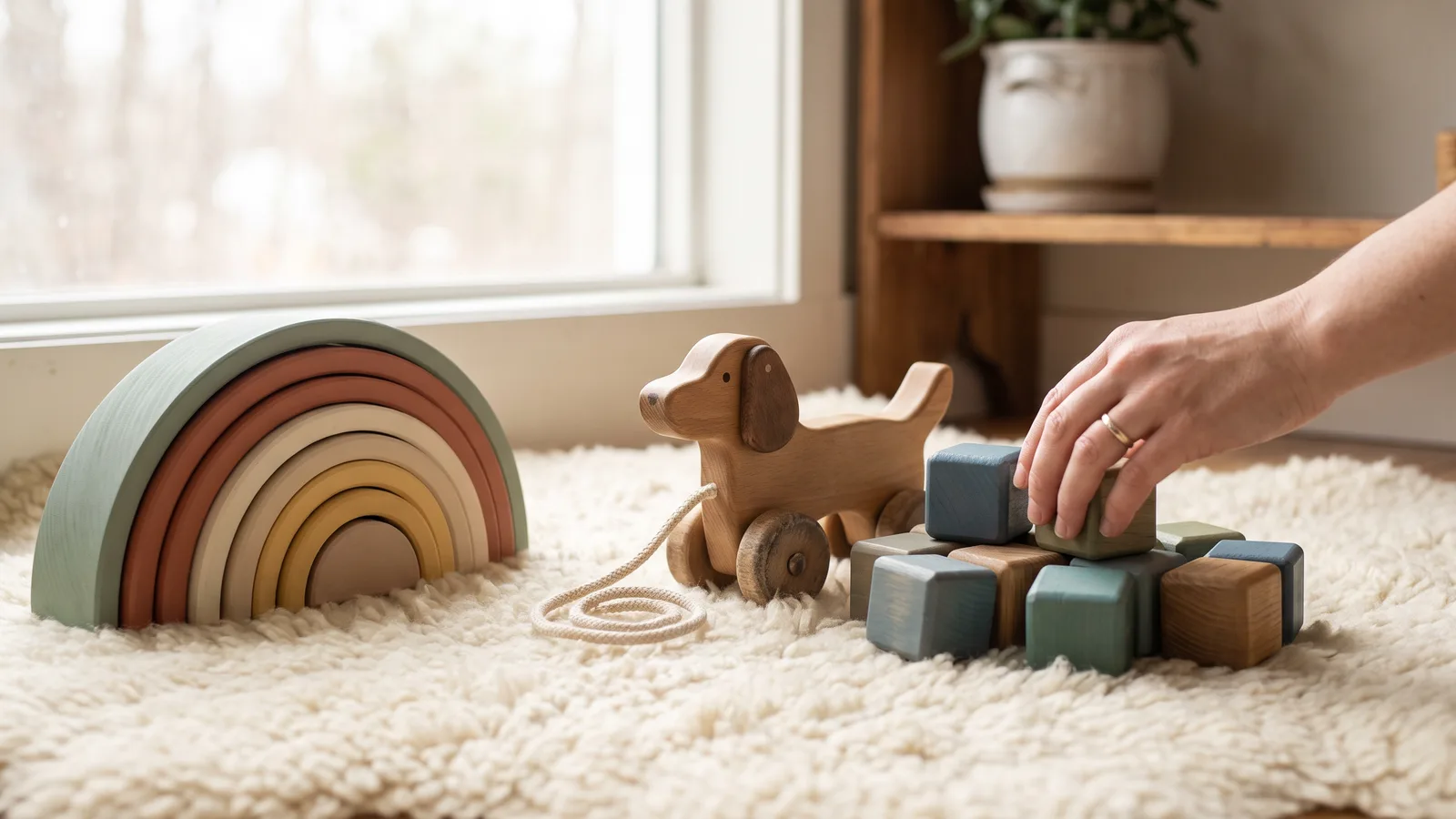
Wooden toys have a way of outliving the childhoods they were bought for. A well-made set of blocks or a stacking rainbow gets passed down, chewed by a second baby, and ends up on a shelf as a keepsake. Handmade wooden toys can also be wonderful gifts, as long as they're made with children's safety in mind.
Here's what we check before suggesting any wooden toy.
Safety comes first: look for the mark
In the EU and UK, toys for children under 14 must meet the EN 71 toy safety standard and carry a CE (EU) or UKCA (Great Britain) mark. In the US, children's products must comply with ASTM F963 and the CPSIA, and be certified by the maker. Responsible small toy makers do this testing, and they say so in their listings.
If a listing says "for decorative use only" or "not a toy", take that seriously. It often means it hasn't been tested for small children.
Small parts and the choke test
For children under three, any piece small enough to fit inside a toilet-roll tube is a choking hazard. Check:
- the size of every piece, including wheels, pegs and beads;
- that axles and pegs are glued or fixed firmly, not just pushed in;
- that cords on pull-along toys are short (under 30 cm is a common guideline).
Wood: hardwood beats softwood
Look for hardwoods like beech, maple, cherry or walnut. They're dense, resist splintering and stand up to chewing. Beech is the classic toy wood in Europe: pale, smooth and hard. Softwoods like pine are lighter and cheaper but dent and splinter more easily.
Avoid toys made from MDF or plywood for very young children unless the maker confirms they're toy-safe and low-emission.
Finishes: what's on the surface matters
Babies put everything in their mouths, so the finish matters as much as the wood. Good options:
- Natural oils (food-grade linseed or similar) and beeswax: they soak in and leave a soft sheen.
- Water-based, toy-safe paints and stains: ideally the maker states they comply with EN 71-3 (which limits heavy metals) or equivalent.
- Unfinished wood: perfectly fine if well sanded.
Ask the maker if the listing doesn't say. A good toymaker will know exactly what they used.
Edges and sanding
Run a finger along every edge in the photos (well, with your eyes). Corners should be rounded and surfaces silky. Handmade toys are often better here than factory toys, because a maker sands each piece by hand.
Open-ended toys get played with longest
The toys that last in a playroom tend to be the simplest: blocks, stackers, animals, a wooden car without buttons or lights. They grow with the child, from mouthing and stacking to building and storytelling.
Great ages-and-stages picks:
- 0–12 months: rattles and teethers (one solid piece, no small parts), grasping rings
- 1–3 years: stacking toys, chunky puzzles, push-along animals
- 3–6 years: block sets, name puzzles, small-world figures, a play kitchen accessory set
- 6+ years: marble runs, building kits, puzzles with more pieces
Personalised toys
A child's name carved or painted on a puzzle is a lovely touch, and genuinely helps with letter recognition. Check the spelling twice (see our guide to personalisation without mistakes) and order early; personalised pieces usually take longer to make.
Caring for wooden toys
Wipe with a damp cloth and mild soap; never soak or put them in the dishwasher. If wood looks dry, a little food-safe oil or beeswax brings it back.
If you'd like to browse, start with wooden name puzzles or beech-wood stacking toys, and look for listings that mention safety testing. Our gift guide for new parents has more ideas.