How to choose and hang art prints like you meant it
Paper, sizes, frames and the 145 cm rule. Everything that turns a print into a wall that feels finished.
We independently choose everything we write about. Some outbound links are affiliate links, which help keep this site running at no cost to you. How we earn.
An art print is one of the most affordable ways to bring an original voice into a home. Many illustrators and photographers sell their work as prints, so the person who made it still gets paid every time someone falls for it. But a beautiful print in the wrong size, frame or spot can look strangely sad. Here's how to get it right.
Know what kind of print you're buying
- Giclée / archival pigment print: made with pigment inks on archival paper. Colour-accurate and lightfast for decades. The best choice for art you want to keep.
- Digital (laser/inkjet) print: fine for posters and casual decor, but may fade faster in sunlight.
- Screen print / risograph: made by hand, layer by layer. Colours are bold and slightly textured, often in small editions.
- Original: a unique painting or drawing. Costs more, and it's the only one in the world.
A good listing names the paper (e.g. "310 gsm cotton rag", "Hahnemühle Photo Rag") and whether the edition is limited and signed.
Standard sizes make framing easier
Choose standard sizes and you can buy affordable ready-made frames:
- A-sizes (Europe): A5 (14.8 × 21 cm), A4 (21 × 29.7 cm), A3 (29.7 × 42 cm), A2 (42 × 59.4 cm)
- Inches (US): 5×7, 8×10, 11×14, 16×20, 18×24
A mount (mat) around the print gives it breathing room and makes even a small print look important. A common combo is an A4 print in a 30 × 40 cm frame with a mount.
The 145 cm rule
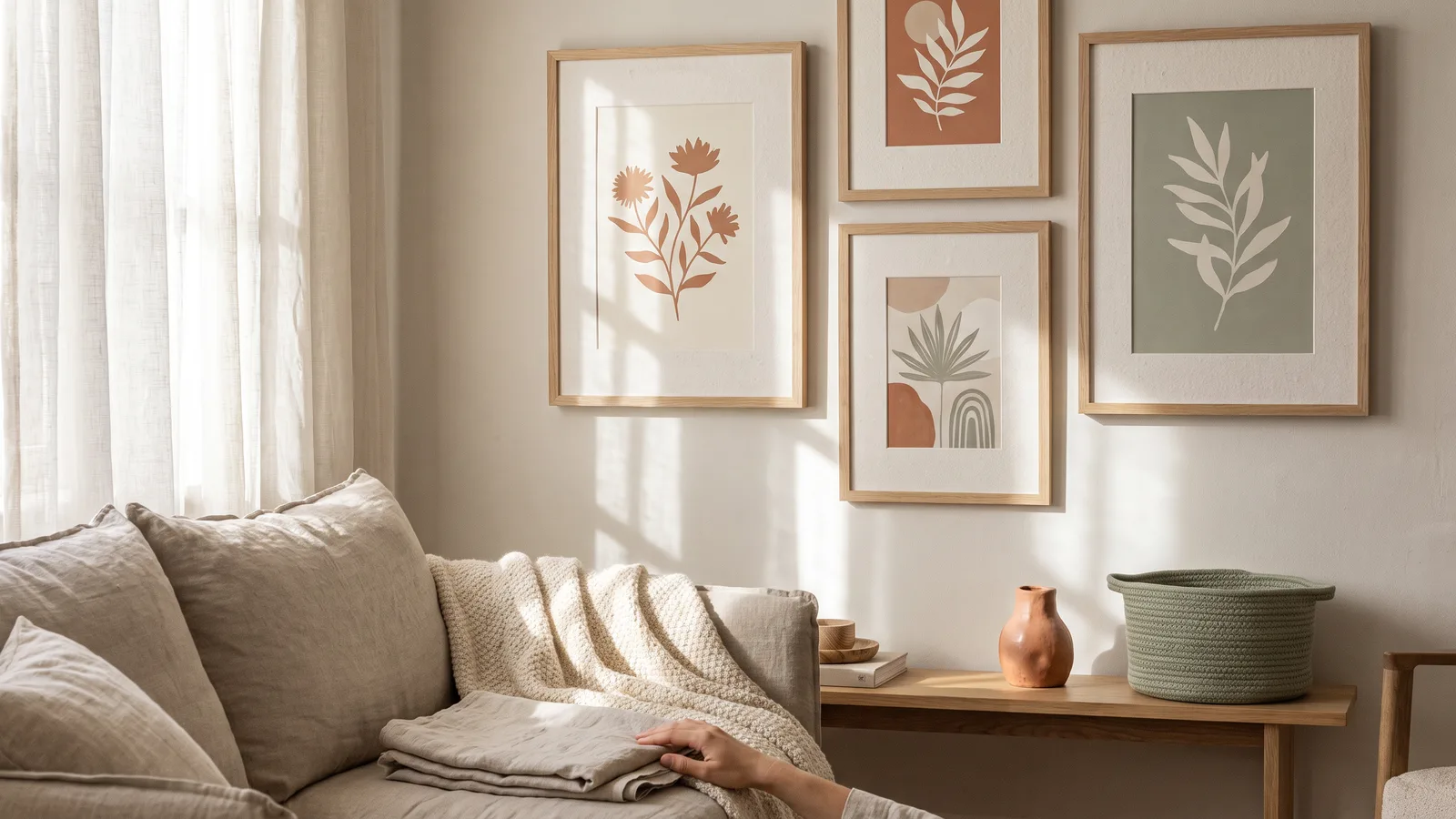
Hang art so its centre is about 145 cm (57 in) from the floor, roughly average eye level. This works for single pieces and for the centre of a group. Above a sofa or sideboard, leave 15–25 cm between the furniture and the bottom of the frame.
Scale: bigger than you think
The most common mistake is art that's too small for the wall. Above a sofa, aim for art (or a group) about two-thirds the width of the sofa. A small print on a big wall looks lost; a small print on a narrow wall beside a door looks perfect.
Gallery walls without the chaos
- Pick one unifying element: same frame colour, same mount colour, or a shared colour palette across the prints.
- Lay everything out on the floor first, then trace each frame onto paper.
- Tape the paper templates to the wall and live with them for a day.
- Keep spacing consistent: 5–8 cm between frames.
Protecting prints
- Keep them out of direct sunlight; even archival inks fade eventually.
- Use acid-free mounts and backing.
- Avoid bathrooms and steamy kitchens unless the piece is sealed.
Giving art as a gift
Art is personal, so it's safest when:
- you know the person's taste well,
- it relates to something meaningful (their city, a pet, a favourite book), or
- you give a custom commission, such as a portrait of their home or their dog.
For a lower-risk gift, give the print unframed in a protective tube with a note: they choose the frame to match their space.
Start browsing with botanical giclée prints, risograph prints or custom house portraits.